
Lodz: An impressive example of city re-generation in Poland

Once called the chimney town by renowned local poet Julian Tuwim the Polish city of Lodz has undergone such a dramatic transformation it is now part of the UNESCO network of Creative Cities and a UNESCO City of Film.
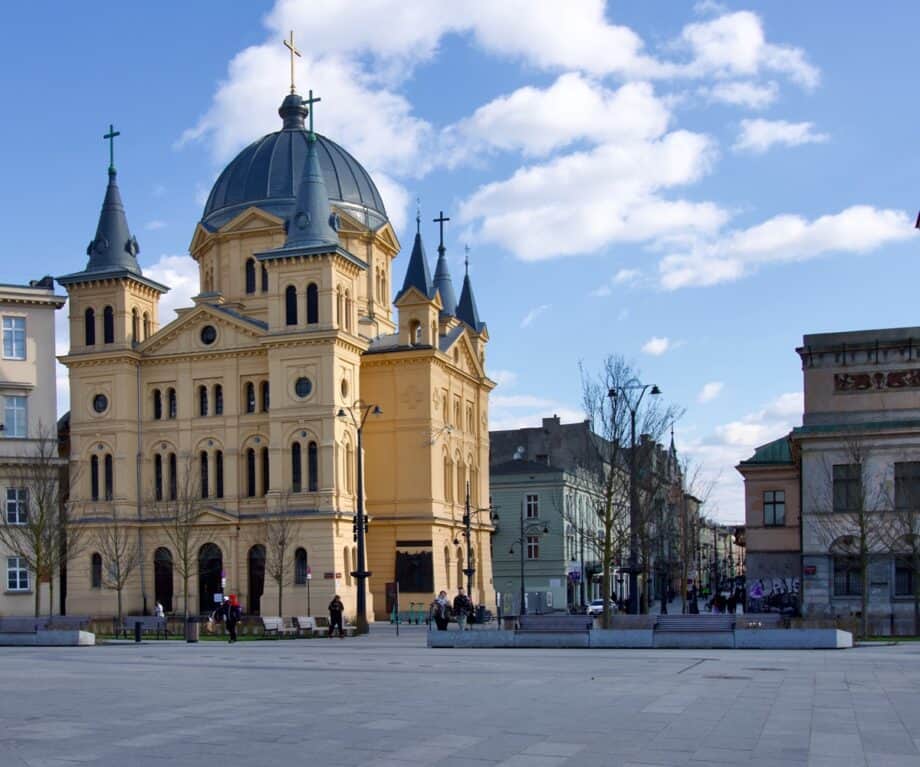
A sensitive re-generation of the city of Lodz recognised and renovated the town’s historical buildings including those in Plac Wolności (Freedom Square). This octagonal square was built in 1823 to serve as the city’s market square. But when trams came to Lodz in 1898 it became a busy traffic circle. Today it is a peaceful area planted with trees around a fountain, benches and a playground for children. Several historic buildings surround this square including the Old Town Hall, The Holy Trinity Catholic Church, the Museum of Archaeology and Ethnography, the Museum of Pharmacy and the entrance to the Sewer Museum. When the textile industry was at its most successful Piotrkowska Street was the street where every businessman wanted to have either his residence or his office. Today the history of the textile industry is celebrated by several installations along this street.
Celebrating the textile industry in Lodz
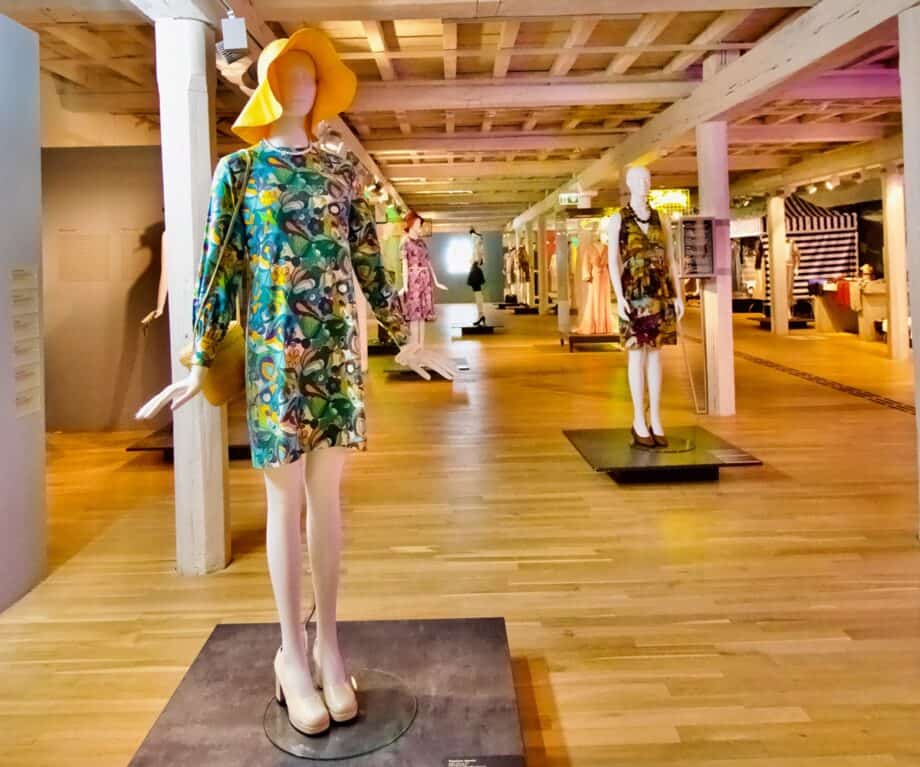
Textiles brought prosperity to Lodz but also a reputation that meant it was shunned as a tourist destination. But today it celebrates this fascinating era with a series of six statues along Piotrkowska Street known as the Gallery of Great Łódźians. These installations include The Manufacturers’ Table which represents the three greatest textile kings whose industrial buildings dominated the town, Izrael Poznański, Karol Scheibler, and Henryk Grohman. Two of the mansions built by these magnates are now museums reflecting the golden era of the textile boom between 1830 and 1914. The palatial state rooms of Poznański Palace on Ogrodowa are open to the public. Poznański’s considerable is reflected in the eclectic mix of architectural styles here. The Museum of Łódź, an exposition of the history of the city, is also in this building. Next door, Poznański’s industrial complex has been converted into a huge shopping and entertainment complex, Manufaktura. Above the main shopping area, the small Textile Museum relates the story of the textile industry in Łódź and exhibits include an original Poznański weaving machine which is still operational.
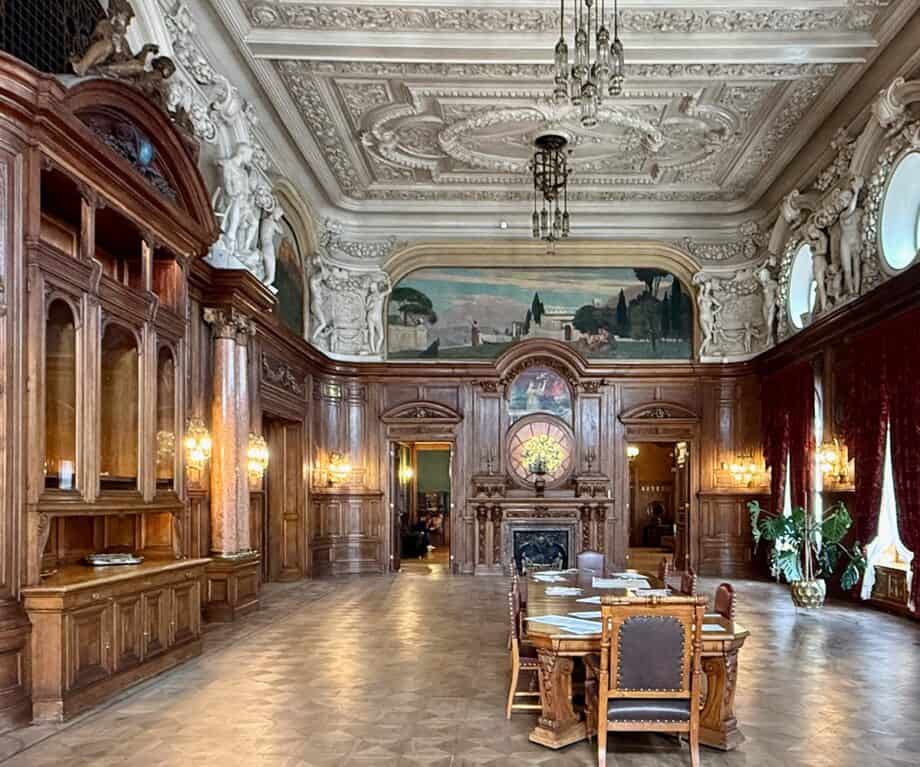
The Herbst Palace Museum on Przedzalniana occupies a neo-renaissance mansion built by Karol Scheibler, the richest of the cotton kings, for his daughter, Matylda. It is named after his son-in-law, Edward Herbst who succeeded him as manager of his industrial empire. This museum features an art gallery and is part of the Museum of Art in Łódź. Nearby is Księży Młyn or Priest’s Mill, an historic industrial estate created during the nineteenth century by Karol Scheibler. A self-sufficient town within the city, it was modelled on English industrial settlements. This enclosed complex included a huge turreted cotton mill, warehouses, workers’ houses, a school, a fire station, two hospitals, gasworks, a factory club, shops, some houses for the owners and a railway siding for Scheibler’s private railway. The collapse of the textile industry brought a change of function for this settlement. In 1971 it was recognised as an industrial architecture monument and a tourist attraction as well as a venue for cultural events. This district has been modernised and former factory workers’ houses have been converted into blocks of flats that include social housing. Despite his prominent position in the textile industry Scheibler did not build the first factory in town, that accolade goes to Ludwik Geyer who built the White Factory on Piotrkowska Street. He was the first to erect a factory chimney in Łódź, the first to use steam engines to power his looms and the only one to paint his factory white. This building is now the Central Museum of Textiles and includes the world’s largest collection of textile art. A cluster of modern museums are also found around the old city power plant in Lodz. The five large buildings on this site have been redeveloped and renamed the Centre of Science and Technology.
The Centre of Science and Technology at EC1 in Łódź
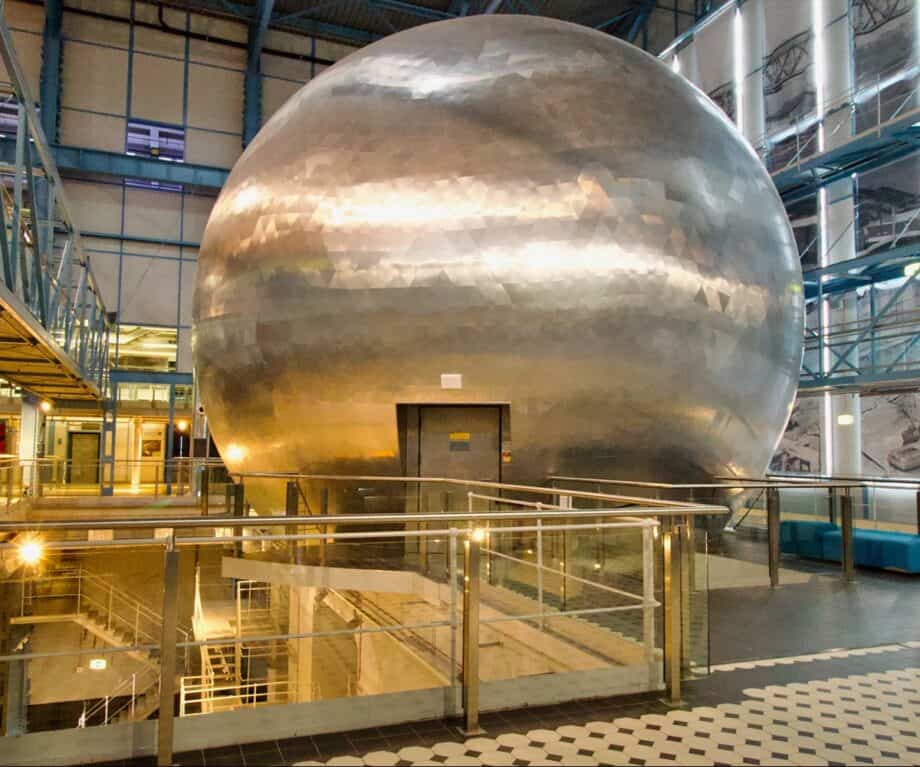
The old city power plant was opened in 1907 and remained operational until the beginning of the twenty-first century. In 2008 its revitalisation and transformation into a cultural, educational and entertainment centre began. The Science and Technology Centre is now the largest centre of its kind in Poland. It features a state-of-the-art planetarium and the opportunity to experience the running of a power plant as well as many other inter-active opportunities. An outdoor terrace above the fifth floor has a great panoramic view of the city below. On the same site is the Centre of Comics and Interactive Narration. This unusual museum features an educational space dedicated to the art of comics, video games, gaming and virtual reality. The National Centre of Film Culture, in the same complex, celebrates the considerable contribution of Poland and Łódź to the film industry. This huge, modern gallery tells the stories of some moguls in the film industry and its exhibits will evoke many memories for cinema goers. It is complemented by the smaller Film Museum on plac Zwycięstwa.
The film industry and street art in Łódź
The Film Museum occupies a nineteenth century villa built by the cotton king, Karl Scheibler. A wide range of exhibits relating to the film industry over the ages are displayed in the original rooms of the villa. The rooms in the villa were also used as film sets when Łódź became the centre of the Polish film industry following the destruction of Krakow during the Second War. The cinema has a special place in the hearts of the people of Łódź as films were the only form of entertainment for a large illiterate workforce in the textile industry. This affection is illustrated by the HollyŁódź Walk of Fame on both sides of Piotrkowska Street in front of the historic Grand Hotel. Around ninety plaques represent well-known personages in the world of movies. This love of cinema is also reflected in the street art of Łódź which is now Poland’s capital of street art.
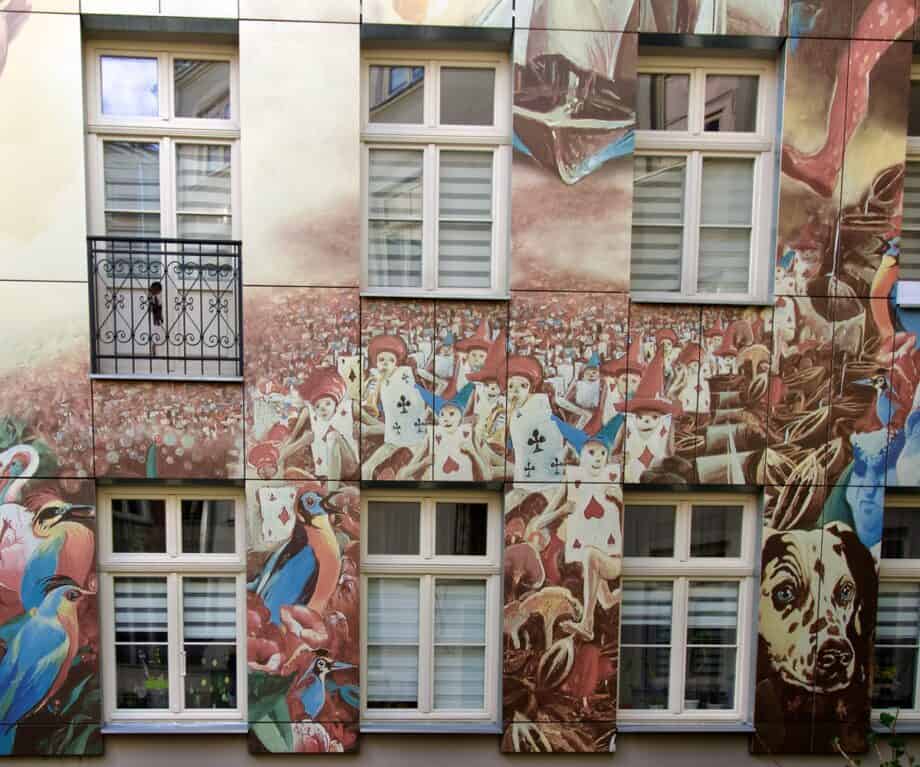
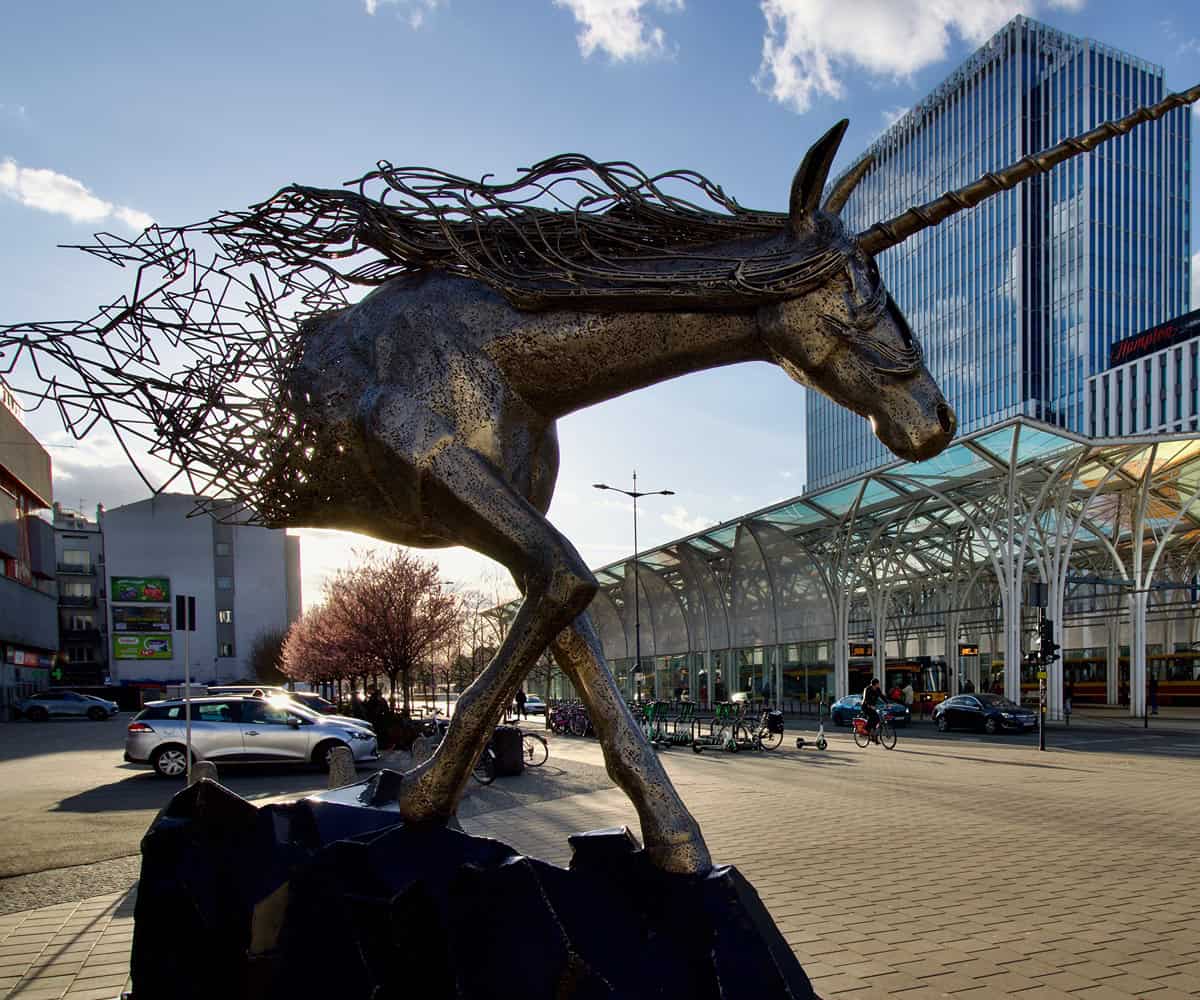
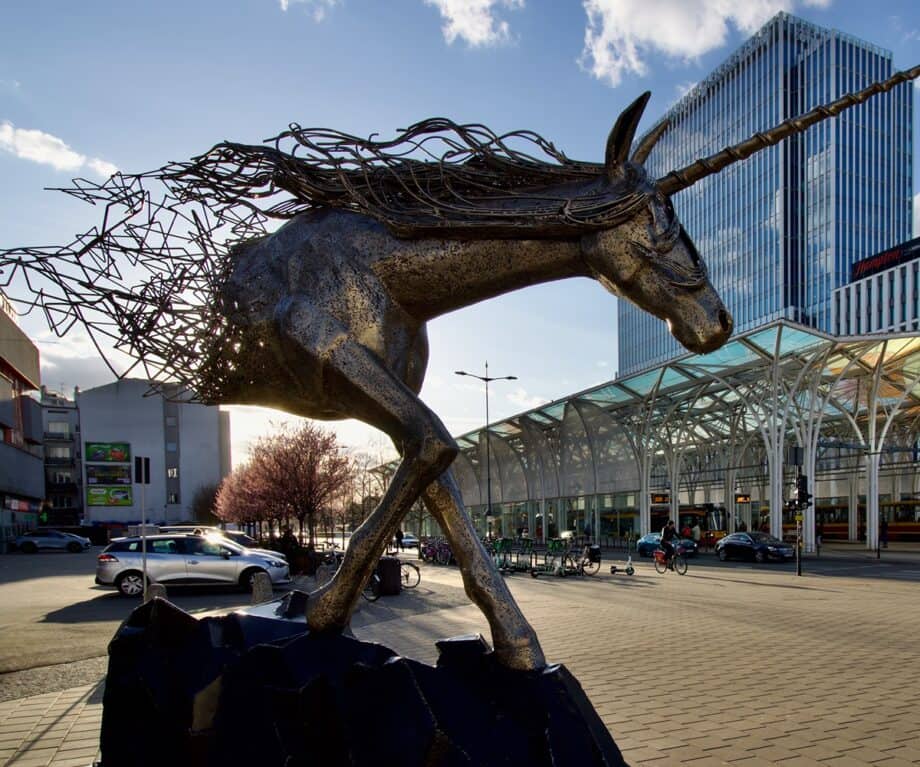
Around 200 large-format murals decorate the buildings of Łódź including the Kino Raj mural dedicated to the cinema at 112 Piotrkowska Street and one entitled Łódź at 152 Piotrkowska Street. The latter portrays a boat sailing out of Wolności Square and very relevant as Łódź means boat. Other art installations of note are Rose Passage (Pasaż Róży) and Birth of the Day (Narodziny Dnia) both just off Piotrkowska Street and two of the artistic backyards for which Łódź is becoming famous. But the installation that has probably created the most controversy is the unicorn outside the tram station, Piotrkowska Centrum, on Piotrkowska Street. A whimsical idea that this innovative steel structure topped with a multi-coloured glass canopy represented the stable of a unicorn resulted in commissioning Japanese artist, Tomohiro Inaba, to create a Unicorn Monument. But it only represents half its body. Does this represent the idea that humans only get a fleeting glimpse of this mythical creature before it vanishes? It is up to the observer to decide.
Close to the Unicorn Stable is a converted cotton mill called OFF Piotrkowska. This complex of offices and workshops that the long-established tradition of textiles also features a large outdoor eating area surrounded by restaurants including the popular Spółdzielnia restaurant. This restaurant serves the local zalewajka, an unusual soup. Dobry apetyt!

Valery Collins
Valery Collins is a travel writer from south-west England, UK. Her passion for travel covers everything from luxury safaris to sylish ski goggles. A keen photographer Valery uses her own images to ullustrate her writing and social media posts.
Did you enjoy this article?
Receive similar content direct to your inbox.

Apologies for the lack of accents!!! Lodz looks a brilliant place to visit. Until I read this I hardly know anything about the city.
Hi Brian
Good to hear from you. I enjoyed evertything about Lodz, unique attractions, great choice of good restaurants and a great vibe. I hope you get to enjoy it yourself one day.
There’s a lot of cities around, like Lodz, who’ve undergone a vibrant transformation. I’ve recently visited Leeds and that’s really smartened up its act in similar style.
Hi Lydia
Thank you for taking the time to comment. I agree many cities are developing some stunning tourist attractions both home and abroad. I have not been to Leeds for many years now but I will bear it in mind if I am going that way.
Piotrkowska Street must be the place to start as it pulls together history, art, business, and modern culture all in one place.
That should give a good overview for the rest of the visit shouldn’t it?
Hi Sarah
Thanks for your observation. Yes, Piotrkowska Street is a good place to start or Freedom Square at the top of that street.
The ceiling detail at the The Herbst Palace Museum is enough to make me want to visit, wow!
Thanks for commenting Jared.
Yes, very impressive. It has been beautifully restored but very few pieces of furniture are original as one of the wives shipped the entire contents to her home country!
The UNESCO creative cities network is new to me. I’m guessing that there are a number of cities who’ve reinvented themselves as Lodz has.
Hi Lydia
Thanks for your comment. This network was something I discovered when In Lodz and was surprised to learn later that there are 408 cities worldwide in this network from Aberystwyth in Wales (Literature) to Zaragoza in Spain (Gastronomy). Good to see UNESCO encouraging and recognising growth in these activities.
My daughter’s got a deep obsession with street art and her husband seems to go along with. She’s fixated with taking photos of what she finds. Lodz will surely be one of her targets very soon.
Hi Jean
Thanks for taking the time to comment. I share your daughter’s passion and hope she gets to enjoy the sreet art in Lodz as much as I did. Apparently, the tradition of painting murals on the buildings began when the city was full of dilapidated buildings and the paintings brightened them up.
Nothing wrong with a controversial half there unicorn. Good art challenges the grey matter.
Hi Stephen
Thanks for commenting. I agree art should be challenging and I think the unicorn in Lodz is just that – I love it.
I enjoyed the section about the film industry as I never realised how important Lodz became after the destruction of Krakow during the war.
Would have been nice to have had a few more images as Lodz is clearly a very photogenic city.
Hi Pradeep
Thanks for taking the time to comment. Yes, the importance of Lodz to the film industry is a fascinating story and I could have spent all day in the two museums reflecting this.
Hi Pradeep
Thanks for taking the time to comment. Yes, the importance of Lodz to the film industry is a fascinating story and I could have spent all day in the two museums reflecting this. If you want to see more images of Lodz check out two other articles I wrote about my experiences in Lodz
Piotrkowska, an Historic Street in Łódź, a City in Poland
Łódź, a UNESCO Creative City in Poland
I get the impression that if want to get to the real roots of the city then you have to drop into the Gallery of Great Łódźians to see how the city continues to honour the industrialists who shaped its identity.
Hi Bob
Thanks for commenting. You are correct to get the feel of this city in its heyday as the capital of the textile indusry in Poland walk the length of Piotrkowska Street. Gallery of Great Łódźians is a series of sculptures along that street plus the mansions they lived in. The industrial buildings are in a different area in and around the town. Manufaktura, now a shopping mall, is close to Piotrkowska Street is a good example of the huge factories built in that era and across the road are the tenement buildings that are gradually being refurbished and turned into flats.