Ancient African rock art at Bushman’s Kloof in South Africa

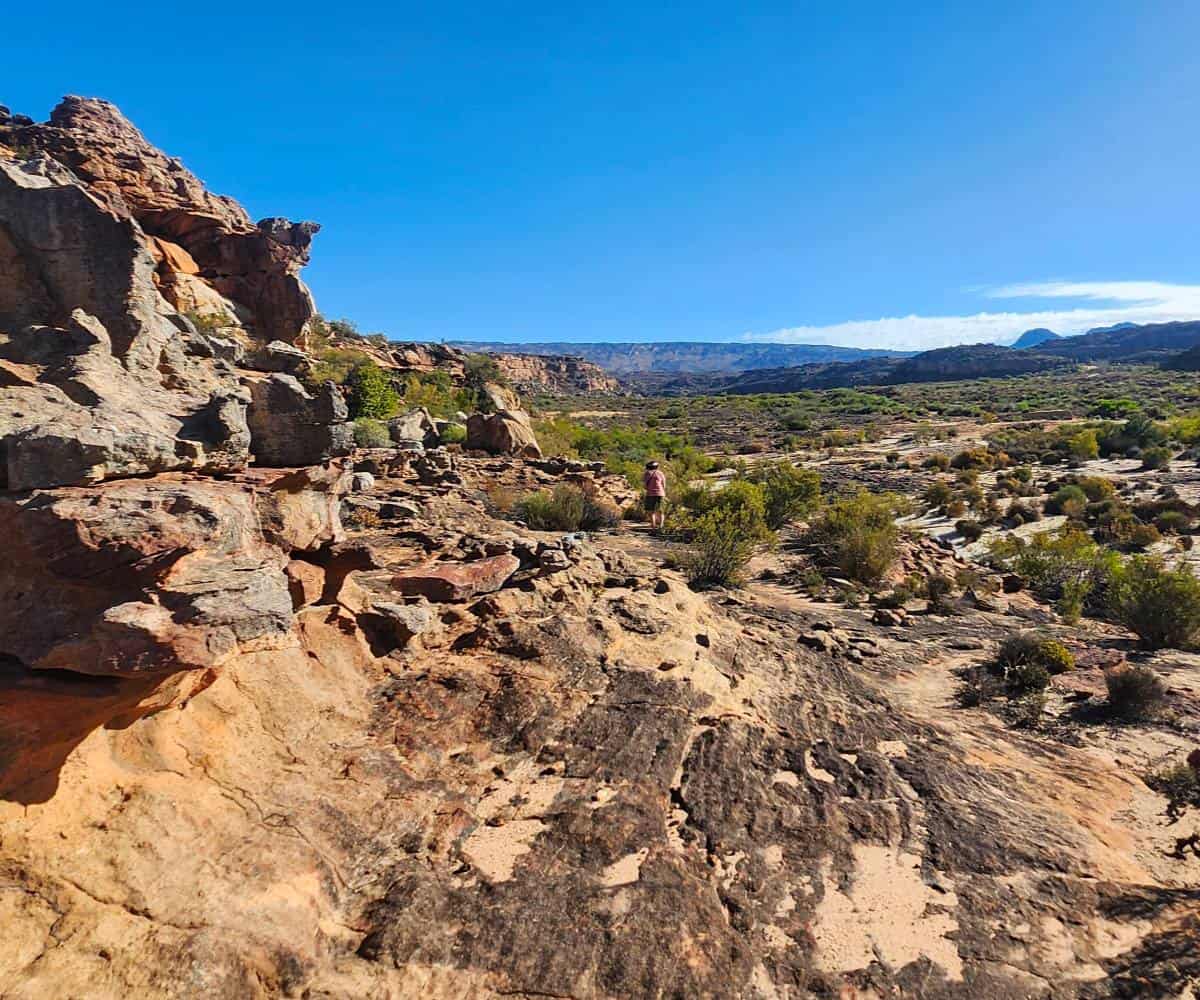
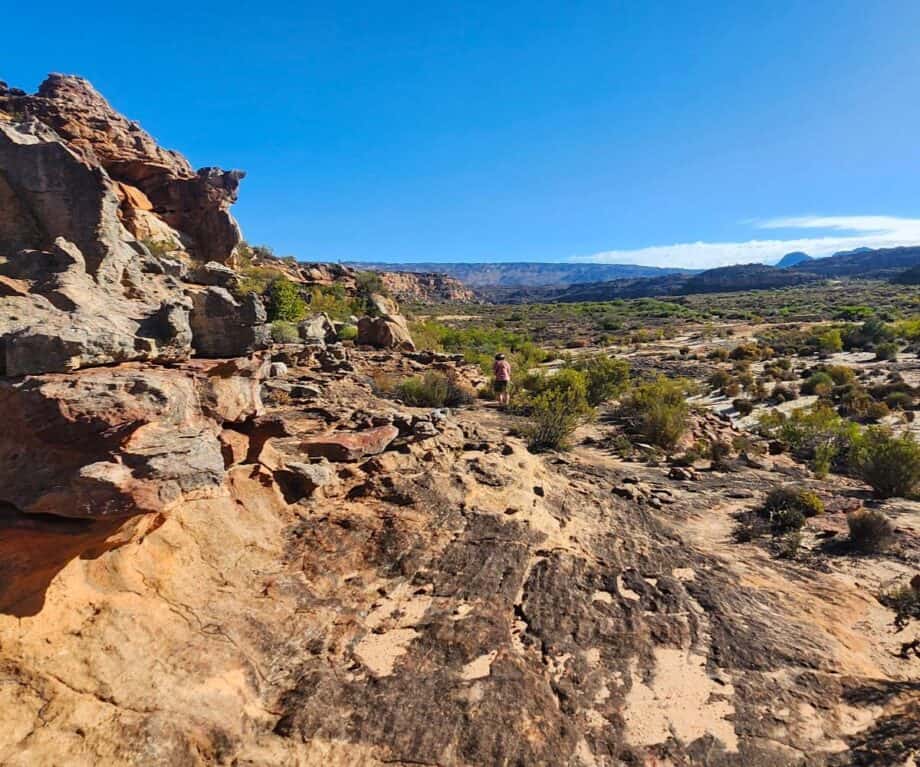
Early one morning, five of us climbed aboard a safari vehicle and headed into the Bushman’s Kloof wilderness of the Cederberg Mountains in South Africa’s Western Cape. This was not, however, a safari in the usual sense. We had no expectations of seeing lions, elephants, giraffes, or any of the other fabled African game animals.
Instead, the guide drove us through a scrubby landscape to a gallery of ancient rock art, the legacy in rust-red of the ancient San people who once called this region home. “This is one of more than 2,500 rock art sites in this region,” our guide Tristan Kapp explained. “UNESCO recognizes the Cederberg as a World Heritage Site for the abundance of these paintings. We don’t know exactly how old they are, but estimates range from 3,000 to 10,000 years. All of it is the work of an ancient people known as the San. Their art is so revered that some of it appears on the South African crest.”
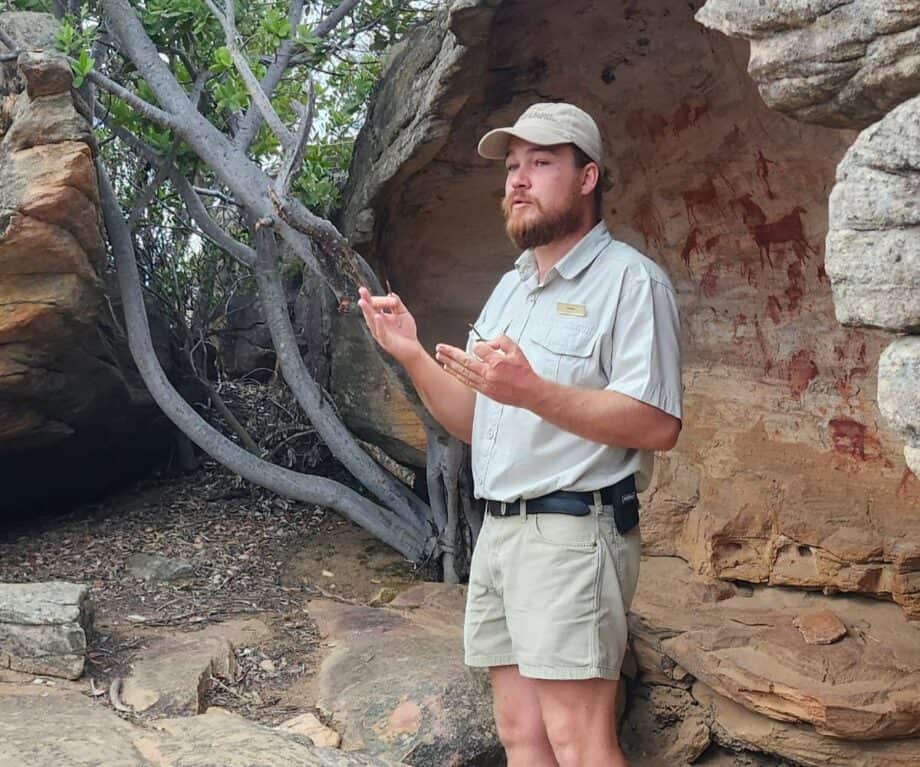
“The Europeans called them ‘Bushmen’, but that term is now considered pejorative,“ Kapp continued. “The San are one of the oldest surviving cultures in southern Africa. Genetic evidence suggests that they diverged from other humans between 100,000 and 200,000 years ago. They were semi-nomadic hunter-gatherers who traveled in small groups following the seasonal animal migration.”
The first paintings we saw covered the back wall of a shallow cave. Stick figures abounded, singly and in groups, as did elephants, antelope, and what may have been wildebeest. Kapp began by pointing to a picture of an elephant with arrows in its head, flanked by a baby and two men with bows. “An automatic assumption would be that they were hunting an elephant,” he began, “but they have no way of killing an elephant.” He suspects the painting is telling a different story. “The baby is painted with its trunk up—it’s trumpeting an alarm to call for its mother, and we know that mother elephants are very aggressive when it comes to protecting their babies,” he continued. “Realizing they’re in trouble, hunters fire a few arrows and run away.”
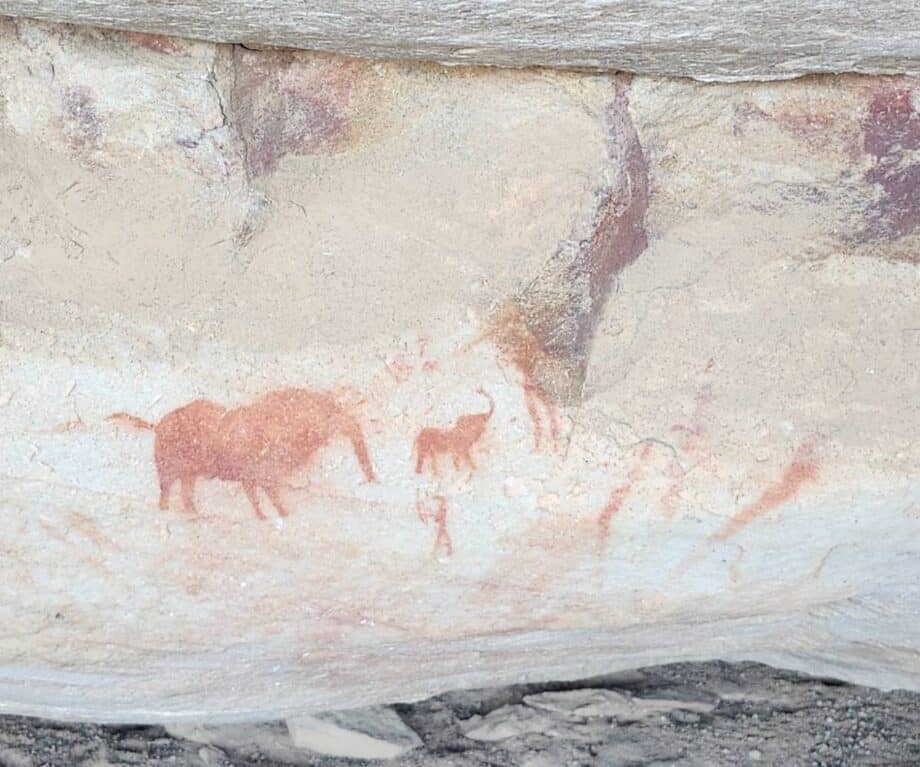
As Kapp looks at the grouping, he sees it as a visual learning aid. “This could be a way of issuing a warning,” he suspected. “It says, ‘if you get too close to a baby elephant, the mother will get angry and potentially come after you’.” That is, Kapp went on to admit, “one possible hypothesis.” But there is a basis for it. “In the late 18 th century, two researchers, William Bleek and Lucy Lloyd, learned the San’s click language so they could interview them, beginning with those that lived on their farm. It’s their archive, which has something like 15,000 pages, that has helped us interpret what we’re seeing, especially when it comes to their spiritual world.”
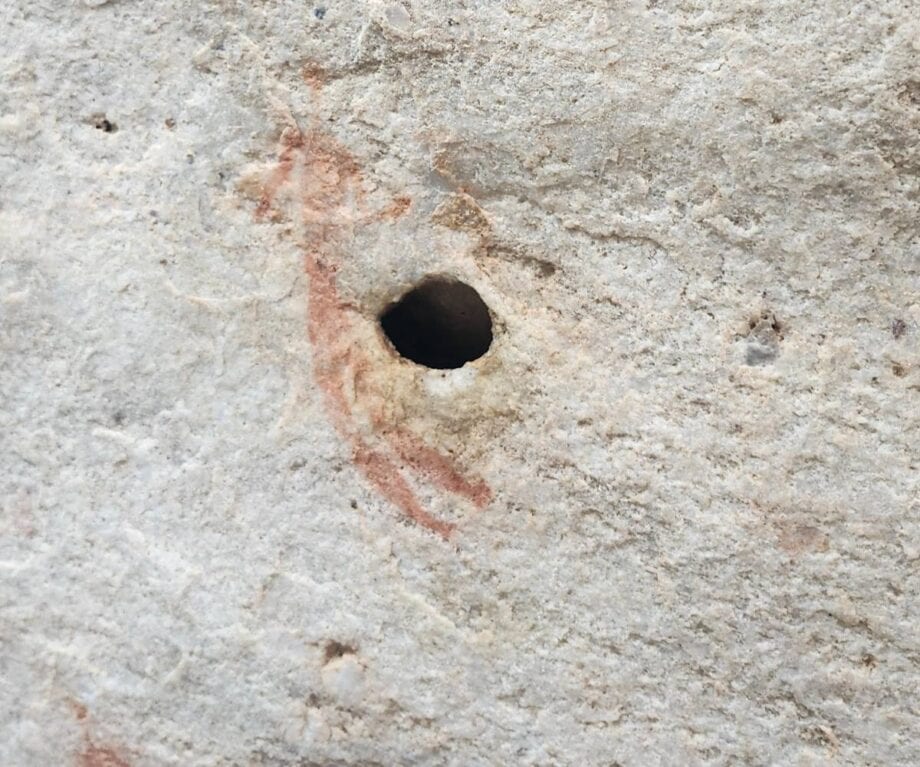
“The San believed that what you painted on these walls would be visible in the spiritual world as well,” he went on, pointing to a figure painted next to a natural hole in the rock. “If white walls acted as a window or a veil, a little hole like this one would be a passageway to the world beyond, so the figure close beside it would most likely be a shaman, perhaps in a trance state.”
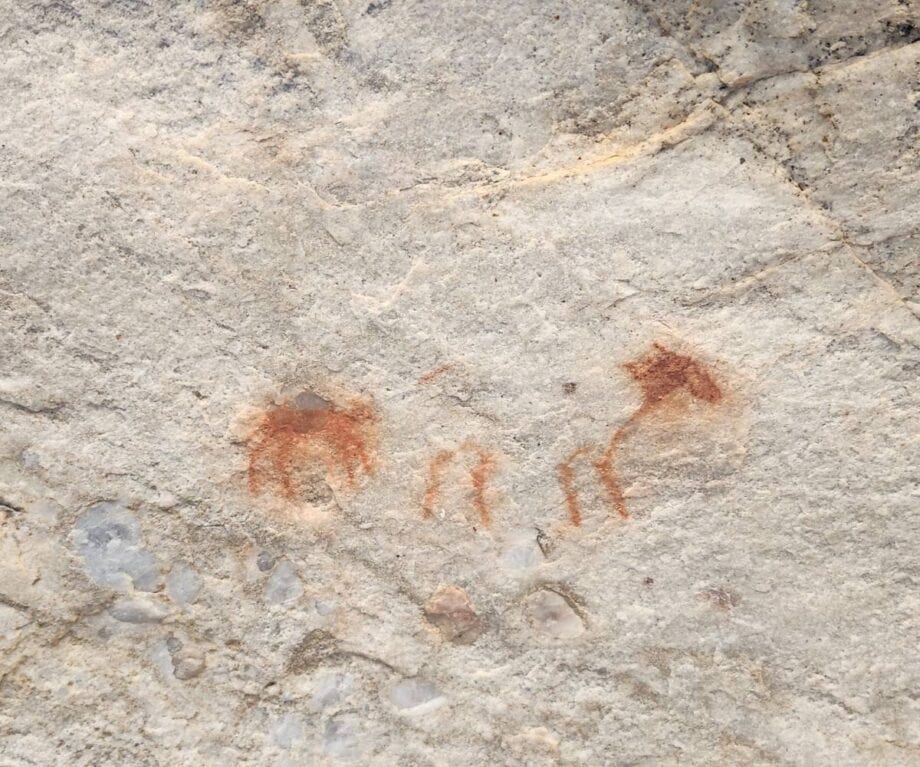
We visited two different rock-art sites. With Kapp’s help we could see that a cluster of stick figures—all male—probably chronicled a coming of age ceremony; a drawing with lines connecting one character with two others could be a shaman making a spiritual connection with them; an animal with pointed ears and a curved tale depicts local Cape leopard; and then some of them were just doodles, an idle diversion on a rainy day. Although some of these were a bit crude, others had very fine lines, delicate enough to suggest arrows or the string of a bow. These are not details that could be done with a finger. “The San used tools to paint,” Kapp told us. “One likely candidate is a feather—not the quill, which they’d stick into a hollow reed as a holder—but the bristles. You could turn it one way to paint very, very thin lines and the other way to produce broader strokes.”
Pigments for painting came from several sources. “The red we see is red ochre, a stone that is very common around here,” he told us. “They would grind it against sandstone to get a red powder. They also used yellow ochre for yellow, charcoal for black, and ground-up ostrich shell for white. To make paint, they’d mix any of these colors with liquid animal fat to create what is essentially oil-based paint to work with. Today, we only see the rust-colored red,” he continued. “But that’s not the paint. That’s the pigment that penetrated the rock. The yellows, whites, and blacks are all gone.”
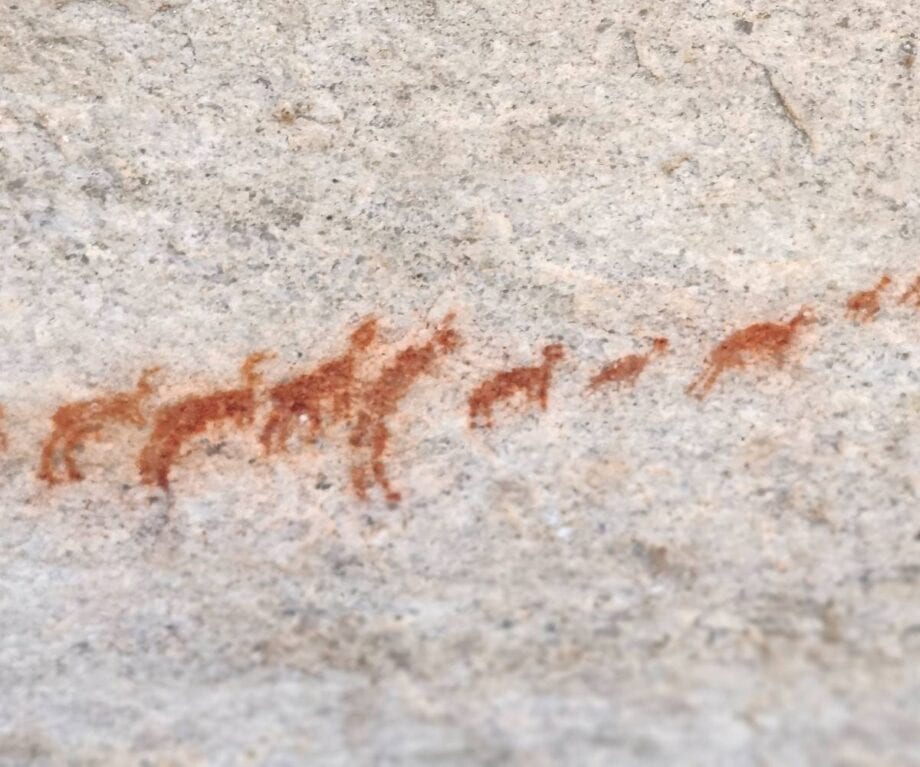
He pointed to an example of a probable sheep. “Another group that inhabited this region, the Khoi, were sheepherders, and it’s possible they raised a black-headed breed that’s very popular in this area. I grew up on a farm, so when I look at this drawing, it immediately says sheep to me. It has the same-shaped head, a bit of a neck, and what would have been a white body. Next to it looks like a newborn lamb—its legs are way too long for these small little bodies.”
Like the white paint on the sheep, some of this art will disappear, eroded by wind and water, buried when the sandstone collapses, and, most distressing, by the vandalism of insensitive visitors.
Most of this rock art is accessible to the public. Maps of routes are readily available in the local town of Clanwilliam, so I could have headed out to explore this rock art on my own. But it’s one thing to see the art; another to understand it. I’d chosen to stay at Bushman’s Kloof, a tranquil wellness retreat within the nature reserve, in part because it offered daily rock-art tours.
Beyond the appeal of the guided tours, this wilderness lodge is most alluring as an indulgent sanctuary. It has just 14 rooms and suites and two villas, scattered through an oasis of lawn and verdant trees beside a narrow, seasonally dry river. Every room has a private terrace with wilderness views, and each has been individually decorated with a collection of handpicked art, antiques, and heritage furniture pieces. There are four swimming pools, a spa, hiking and mountain biking trails, and a lake for canoeing. Breakfast, lunch, afternoon tea, and dinner are all included, as are the rock-art tours and a late-afternoon game drive. It also maintains a Heritage Centre, with information and artifacts to help you to delve deeper into the art and ancient culture of the San people.
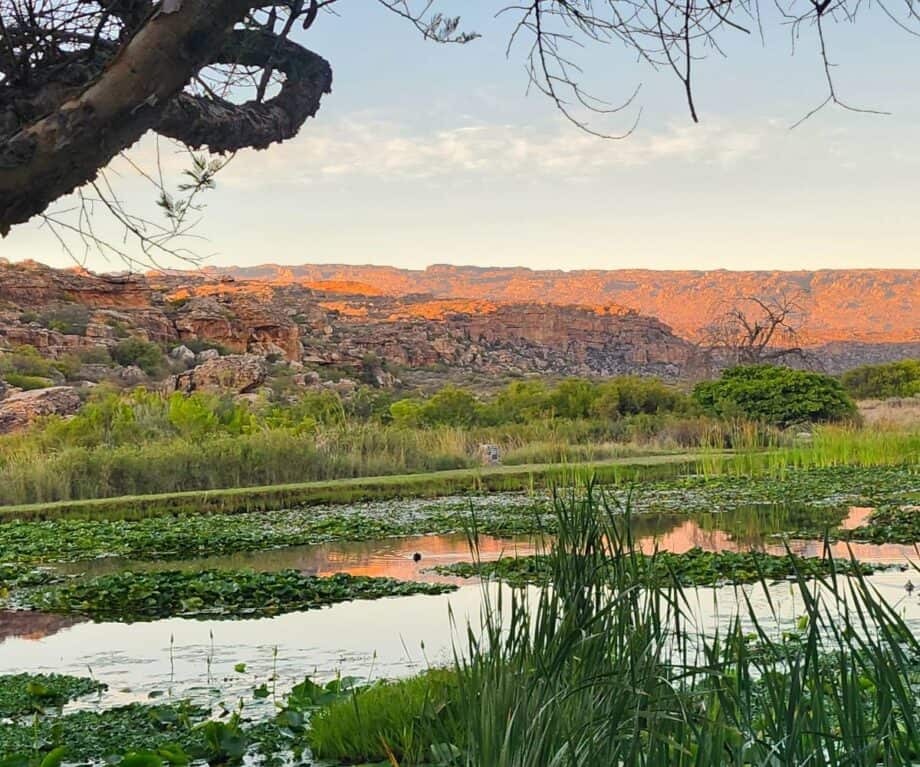
Its setting is also part of the Cape floral region, a biodiverse landscape called fynbos—Dutch for “fine bush”—with some 9,000 species of plants, among them laurel protea, red disa, snow protea, and, high on the mountain cliffs, the now rare Clanwilliam cedars, from which the region takes its name. Finally, the Cederberg is famous for rooibos, a plant grown nowhere else and famous as a healthy tea—a chilled glass of which you receive on arrival.
Bushman’s Kloof Wilderness Reserve & Wellness Retreat is 270 km (170 miles) north of Cape Town, South Africa. Lodging rates vary seasonally.

Roger Cox
Roger Cox is a travel writer from New York, USA He is a veteran travel journalist whose work has appeared in Luxury Magazine, Travel+Leisure, Esquire, The Robb Report, and many more.
Did you enjoy this article?
Receive similar content direct to your inbox.