
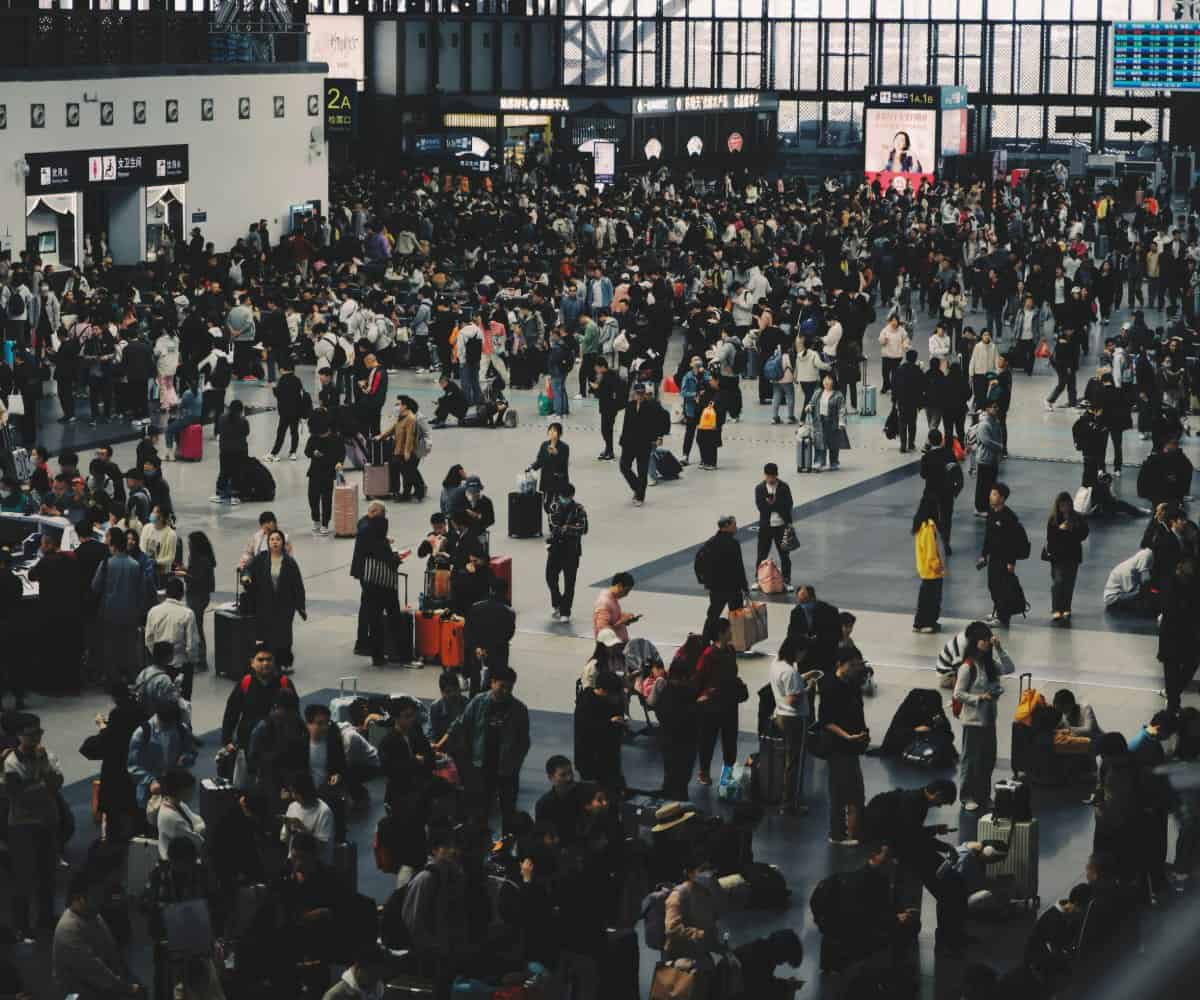
Airport traffic predicted to more than double… are we ready for it?

Fasten your seatbelts — the skies are about to get crowded. By 2053, global air travel is projected to reach a staggering 22.3 billion passengers annually, more than double the numbers expected in 2024. This isn’t just an incremental rise; it’s an aviation explosion. The world is on a trajectory towards unprecedented demand, but the real question remains: can airports, airlines and policymakers handle the turbulence ahead?

A meteoric rise in passenger traffic
According to the latest report from ACI World, air travel is set to grow at an annual rate of 3.4% over the next two decades, climbing to 17.7 billion passengers by 2043 and soaring to 18.7 billion by 2045. That’s a colossal shift from the 9.5 billion passengers recorded in 2023 — a figure that already reflected a 9% year-on-year increase. The industry, however, continues to wrestle with the aftershocks of the pandemic, with the original 2024 projection of 11.4 billion passengers proving overly optimistic.

The global recovery: Who’s taking off first?
By 2025, air travel is expected to stabilise, with global traffic reaching 9.9 billion passengers—marking a 4.8% growth rate. But not all regions are accelerating at the same speed. Africa is poised to reach 236 million passengers in 2024 (107% of pre-pandemic levels), while Asia-Pacific and Europe are both expected to hit the 5 billion mark (103% and 102% of 2019 levels, respectively). Meanwhile, North America is forecasted to exceed 1 billion passengers, and Latin America and the Caribbean are set to outpace pre-pandemic levels with 746 million travellers (111% of 2019 levels).

But the real high-flyers are the Middle East and Asia-Pacific, leading the global charge with anticipated annual growth rates of 5.2% and 5% between 2024 and 2030—outpacing the global average of 4%. Emerging economies are proving to be the industry’s new powerhouses, driving demand beyond the reach of legacy aviation hubs.
The headwinds ahead
While the numbers paint a picture of boundless growth, geopolitical turbulence threatens to disrupt the ascent. A potential resurgence of trade tariffs under a second Trump administration could cool international travel demand, while ongoing conflicts and economic instability in key regions pose additional risks. Adding to the pressure, aircraft manufacturers are struggling to keep up with delivery schedules, creating bottlenecks in fleet expansion and driving up operational costs for airlines.

Justin Erbacci, Director General of ACI World, warns that the aviation sector cannot afford complacency. “Airports, airlines, and policymakers must take bold, forward-looking actions to anticipate and address future needs.” The challenge isn’t just accommodating more passengers—it’s doing so efficiently, sustainably, and safely in a world of increasing uncertainties.
Everything you need to plan your trip in 2026
🌟 Luxury hotel deals from Booking
🏡 Vacation rentals from VRBO
✈️ Flights from KIWI
🛫 Private jets from Private Jet Finder
🅿️ Airport parking from ParkVia
🛋️ Airport lounges from Priority Pass
🚖 Airport taxis from Welcome Pickups
🚗 Car rentals from Discover Cars
🚐 Luxury RV rentals from RVshare
🚢 Cruises from Cruise Direct
🛥️ Ferries from Direct Ferries
🎫 Attractions tickets from Tiqets
🏞️ Tours from Viator or GetYourGuide
🛡️ Travel insurance from Safety Wing
🏥 Medical insurance from World Nomads
🧳 Luggage from Case Luggage
🛅 Luggage storage from Stasher
📚 Travel guides from Lonely Planet
📕 eBooks from Kindle Unlimited
🎧 Audiobooks from Audible
🎬 Movies from Prime Video UK
🎵 Music from Amazon Music UK
💶 Travel currency from Wise
📱 SIMs from SimOptions
🌐 VPNs from ExpressVPN or NordVPN
🛂 Visas from iVisa
The future
With air traffic expected to more than double in the next 30 years, the industry stands at a crossroads. Will infrastructure keep pace with the soaring demand, or are we heading towards a future of endless delays, overbooked flights, and logistical nightmares? One thing is certain—ready or not, the aviation boom is coming. The only question left is will we rise to meet it, or crash under the weight of the industry’s success?


Paul Johnson
Paul Johnson is Editor of A Luxury Travel Blog and has worked in the travel industry for more than 30 years. He is Winner of the Innovations in Travel ‘Best Travel Influencer’ Award from WIRED magazine. In addition to other awards, the blog has also been voted “one of the world’s best travel blogs” and “best for luxury” by The Telegraph.
Did you enjoy this article?
Receive similar content direct to your inbox.


How much of the Middle East’s growth will come through them positioning themselves as a hub for travel between the Northern and Southern hemispheres? Abu Dhabi, Dubai and Qatar have been targeting that trade for years. Now, Saudi Arabia is building fast with a strategy to take a large share of that market too.
If there’s one thing that I’ve learnt in 4 decades of business is that forecasting is far from an exact science. The further you look into the future the less reliable your forecasts are.
Looking ahead to 2053 is staring far into a future that will probably be very different to the present that we know. I’d take doubling of air passenger numbers with a huge pinch of salt.
I’ve had some bad experiences at overcrowded airports. If airport facilities fail to keep up with these numbers there will be a lot of people opting out of air travel.
There’s a limit to how long we’re prepared to queue for the lift to departures, for baggage drop-off, for security, for coffee, for the loo.
The answer to that question will probably come from how the growth is spread out. There are probably lots of small regional airports who are rubbing their hands with glee at the opportunities for expansion and local communities could benefit too.
Probably the biggest question of all is are there enough air traffic controllers and air traffic control systems to deal with the increase?
Or is Air Traffic Control something that Artificial Intelligence could manage?
Some would say that AI is better suited to ATC than humans who get tired and distracted.
From what I see with people taking a couple of overseas holidays a year and flying for city breaks I feel that the trend is definitely on the up for the number of flights taken. Some of my friends are also likely to take some internal flights on their travels too, particularly if they are in the USA, Latin America or India.
That forecast will have the greens hopping up and down and even the most environmentally indifferent people must be concerned what that increase would do to global warming and the environment.
A fascinating and thought-provoking piece which doesn’t shy away from the issues.
To answer your question in a word – No!!!
Yes, the industry is growing but I doubt that the supporting infrastructure is growing fast enough.
What is really troubling is that there’s no global plan to take control of such extreme growth that could lead to considerable global problems. Much of this growth will be facilitated by the profit motive with the merest lip service to green and sustainability principles.
I wouldn’t be so sure about growth in North America air traffic. In the short term, I’ve read a report that suggests revenue from American tourism will decline by $49.6 billion over the next four years. Call it a boycott of Trump’s America or anxiety about visiting the country, whatever the causes, it’s likely to result in less flights.
That really is such a big question and the consequences of that level of rapid growth are simply huge and probably very damaging to the environment. It’s a question that should be debated immediately at a global level as the consequences of such growth will probably hit everyone.
Am I the only one who thinks that the recent fire at London Heathrow demonstrates that the airline industry is literally flying by the skin of its teeth?
Surely one fire shouldn’t have resulted in disruption scanning continents?
Many of us were shocked that there wasn’t spare capacity in the system. Though the National Grid is suggesting that there was spare capacity and that Heathrow Management were unaware of the contingency facilities.
There are some fairly scary stories coming out of the United States too. I read an account by one whistle-blowing air traffic controller who talked about being left on his own with too much flights to keep track off.
Who knows what we will learn from the post mortem into the Air India flight that crash d at Ahmedabad? In the aftermath of that a subsequent Air India flight’s take off was postponed after what were probably enhanced pre-flight checks.
Another interesting factor is going to be how safe will the skies be with the current quantity of international conflict? Surely airspace over Ukraine, Israel and Iran will be out of bounds? And can anyone guarantee that conflict will not spill over into other countries’ air space.
Looking ahead it’s far from blue-sky thinking for the airline industry; there are plenty of clouds that could appear on the horizon.